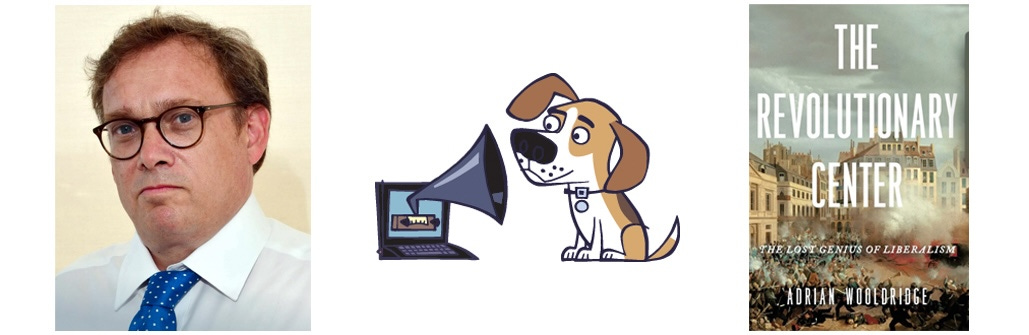
Adrian is a journalist and an old friend. We arrived in America on the same plane in 1984 and spent the first few days together in the same hotel room. After more than 20 years writing for The Economist, he became the global business columnist for Bloomberg Opinion. He’s the author of several books, including The Aristocracy of Talent, and the co-author of many more with John Micklethwait, including The Right Nation. Adrian’s new book is The Revolutionary Center: The Lost Genius of Liberalism. It’s a terrific tonic for a philosophy as vital as it is in eclipse.
An auto-transcript is available above (just click “Transcript” while logged into Substack). For two clips of the episode — on how Enlightenment ideas got corrupted, and Big Tech’s threat to liberalism — head to our YouTube page.
Other topics: raised in rural Shropshire; his parents both teachers; his dissertation on the 11-plus (an exam that changed my life); when IQ tests were a liberal cause; Luther and the Reformation; the religious civil wars leading to the Enlightenment; Hobbes as a proto-liberal; the humanism of Erasmus; Montesquieu and the spirit of liberalism; John Stuart Mill and utilitarianism; Isaiah Berlin and pluralism; Graham Wallas and the Great Society; Lippmann; Leo Strauss; Thatcherism; consumerism vs. self-improvement; meritocracy threatened by the left; Foucault’s folly; the EU and managerial liberalism; Brooks’ bobos; affirmative action and DEI; why liberal democracy in Iraq didn’t work; Oakeshott; Schmitt and friend-enemy; Trump’s stark illiberalism and neo-royalism; King Charles; Putin ushering in a strongman era; Biden’s open borders; the migration crisis and Brexit; the buffoonish Boris; the struggling Starmer; high culture and other upsides to elitism; Abundance; Deneen and post-liberalism; and Europe stepping up for Ukraine.
Browse the Dishcast archive for an episode you might enjoy. We have some real stars coming up: Ben Rhodes on Iran and speech-writing, Harvey Mansfield on modernity, HW Brands on the life of George Washington, John Gray on Trump’s new world, Bob Wright on the evolutionary force of AI, Tiffany Jenkins on privacy in a liberal democracy, Jerusalem Demsas on the state of the left, Daniel McCarthy on conservatism, Stephen Grosz on the struggles of love, and Robby George on pretty much everything. Please send any guest recs, dissents, and other comments to dish@andrewsullivan.com.
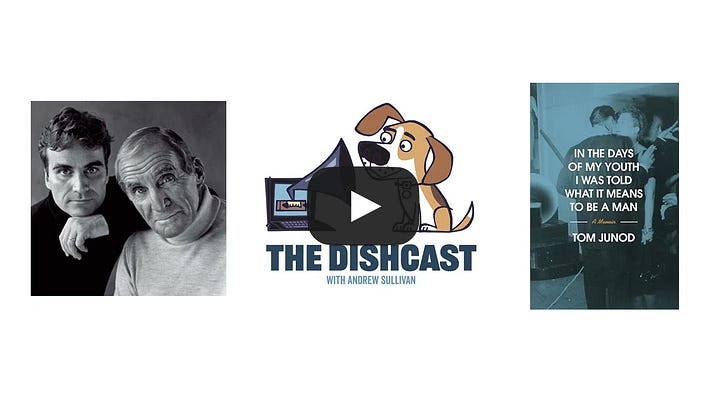
From a fan of last week’s TMI pod with Tom Junod:
OMG. “But wait … there’s more!” 🤣 This conversation feeds my little bitchy soul. I just love a good dish, and this is it! I ordered the book halfway through the episode.
Another fan:
I just listened to your Dishcast with Tom Junod and had to write in, because your conversation was incredibly moving. I’ve been a fan for years, and your podcast is a staple on my Saturday morning drive to the South Bronx, where I practice law. I wish you would release as many pods as Rogan!
I’m 49, married with two kids, and have worked with my father for 24 years — Irish Catholic, Queens through and through. That out-of-borough identity that you and Tom discussed, especially as it relates to Trump, really hit home. I have met many Big Lou-type men throughout my life, so Tom’s reflections on his father resonated deeply. That mix of admiration and complexity felt very real. I listened to a sample of the audio book right after and can’t wait to listen to it as well.
The previous episode with Greg Lukianoff on free speech was excellent as well. Thanks for what you do — it really matters.
Here’s a guest rec:
I recommend you consider Fr. Bill Dailey, CSC as a future guest. He teaches at Notre Dame, where he’s a rector in one of the residence halls, and he’s a member of the Holy Cross community. He clerked in the 9th circuit and is a member of the Federalist Society. He’s also the former head of the St John Neuman Center for Faith and Reason in Dublin.
I seriously doubt that two lower-middle-class, high-IQ, Irish-Catholic bros would have difficulty finding subjects to discuss, but I will be brash enough to propose a few:
His origin story in the rapidly deindustrializing city of Warren, Ohio
Loss of a brother to drugs
How woke Notre Dame is and what he sees on campus today
His view of the Dobbs decision and abortion in general
The current state of the Church
What Patrick Deneen (a faculty colleague) is up to
How he evaluates the performance of his former faculty colleague Amy Coney Barrett
I will conclude with the memory of how you turned me around on gay marriage and acceptance of the LGBT community. In March 1999, you spoke at Queer Awareness Day at Stanford (an event you will not soon be invited to again, as you know), and I saw you on C-SPAN explaining the conservative case for family life. It completely changed my views — thank you.
Ah, yes, the days I was invited to campuses! It’s been a few years. But thanks for the memories. I’ve come to accept that the TQ+ world will write the history of marriage equality and yours truly will appear nowhere. Who cares? We got marriage — which is all that matters.
On last week’s column, “The Ukrainian Miracle,” a reader writes:
I appreciate this piece. I have started to call #47 “Trump the Destroyer, Forcer of Change.” As much as I’ve hated the obnoxious “You don’t have the cards” incident and the insane Greenland threats, Trump has FORCED Europe to get its ass in gear when it comes to its defense — finally. And if anything good comes out of the disastrous Iran war, it will be that Europe and other countries will start doubling down on energy resilience and security (read: solar, wind, nuclear, and geothermal). None of this is what Trump intended, and yet, it could all be for the good.
Another reader on that column:
You acknowledge that Trump may be a world historical figure “despite himself,” and in a later section you comment:
The election and re-election of Trump is proof of American decline. No serious country would dream of electing a deranged, delusional monster not once, but twice.
That’s too simple. And I believe the reality of the situation to be this: Trump is indeed a world historical figure; it’s not entirely despite himself; and he is more than a mere monster. I think Bill Maher may have recently put his finger on the quality, the defining characteristic, that elevated Trump to his current spot on the historic pantheon of world leaders. On his 4/17 show, Maher asked Rahm Emanuel if — during his presumed run for the presidency — he was going to cave in the face of the inevitable onslaught of leftist activism. Rahm implied he would not.
But the real answer is Yes. Of course Rahm will cave. If there’s one astonishing fact we’ve all learned in the last decade, it’s this: every establishment representative at all elite institutions (education, journalism, publishing, entertainment, politics) will cave. The pillars of our liberal society have been hollowed out, and when recently challenged by a wave of illiberalism, they were simply swept away.
Enter Trump. He built his political brand by not caving. And we now know, beyond any dispute, that such fortitude in high-profile personalities is beyond rare. Trump took on one sacred cow after another to win the nomination and then the presidency in 2016, and he never apologized for doing so.
In his decade in politics, Trump has indeed allowed himself to be flattered and manipulated. And he’s been inconsistent on various topics. And yet, as far as I can tell, he remains not just the most prominent American politician, but also one of astonishingly few world leaders who will still call out the BS that no one else of similar stature will condemn.
There are many examples. One of the more famous is Trump’s opposition to open borders. He has also leveled some genuinely constructive critiques at NATO — a once unquestionable institution. But even closer to my own heart is his opposition to the most sacred of all sacred cows throughout the educated classes of the Western world: trans fundamentalism.
At a time when the UK is throwing its own citizens in jail for questioning trans ideology, I found it intensely satisfying to hear the American president refuse to cave on that issue. And in an absolutely morbid piece of irony for the “right side of history” crowd, it was Trump, not them, who was bending the metaphorical arc towards justice.
Your podcast guest Wesley Yang argued that by not just denying empirical reality, but by insisting that the rest of us do the same, gender fundamentalism threatens the foundations of the liberal world order. So, in that case, does Trump not become one of the 21st century’s greatest champions of classical liberalism?
Alas, no. He suffers from the very real vices of his virtues. And the same impressively unyielding instincts that have brought him to genuine historic prominence also led him to deny the results of the 2020 election. And that was an act so discrediting that I would never vote for him.
Nevertheless, I can still recognize that no matter how flawed he may be, he has still managed to alter the course of history through a genuinely impressive blend of steadfast iconoclasm, talented theatrics, and uncanny timing. Yes, he’s a bully, among other things. But have you seen the opposition? They just tried to assassinate him for the third time.
Our historic moment may well have demanded a bully. You may be right, he may be crazy, but 250 years since the Declaration, he could be just the lunatic America was looking for.
I think it’s sensible to forgo a lunatic in the White House, as the entire world is now finding out.
Here’s a dissent over me agreeing with the Joe Klein piece we featured “In The ‘Stacks”:
You ought to reconsider your support of the Supreme Court’s Callais decision. It seems to me that interpreting the Voting Rights Act to allow at least a few black politicians from Southern states to make it to Congress was a good thing — and what will now replace it will make things worse. ...



%26stroke%3Dnone%26strokeWidth%3D3.6)