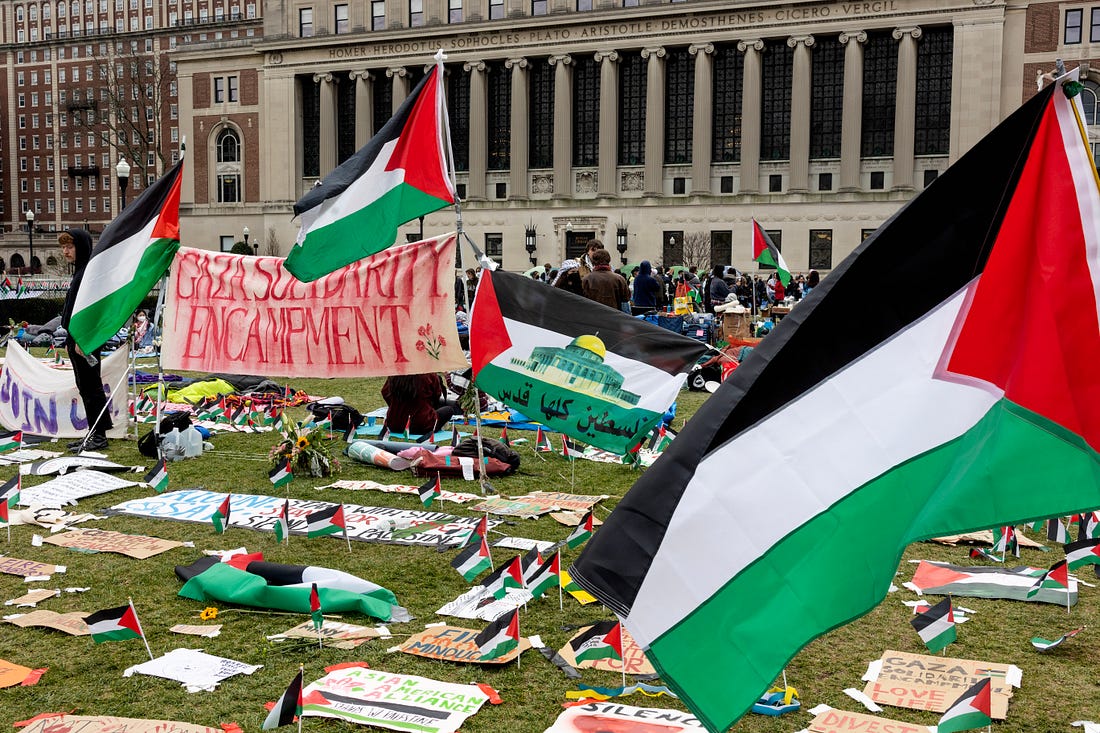

Hi, y’all. Welcome back to The Opposition. Not so long ago, one of the major issues in American politics were the pro-Palestinian student protests that disrupted college campuses across the country. The images of students camping out on quads and taking over school buildings became so prominent that President Joe Biden was forced to address it in a White House speech in the spring of 2024. I’ve written before in this newsletter about how the anti-Trump 2.0 protests look different from those of Trump 1.0. But as 2026 has unfolded—from the killings of Renée Good and Alex Pretti, to the war in Iran and Trump’s threats to commit genocide—I’ve been curious about what happened to all that campus activism. That’s the subject of today’s newsletter. If you’re not already a Bulwark+ member, please consider signing up. Not only will you get full access to all our locked content, but you’ll be joining a community that shares your concerns about the future of democracy. Give it a try: –Lauren The Campus Protest Culture That Targeted Biden Goes Silent for TrumpFiguring out why anti-war activism seems so subdued.
WHEN HAMAS ATTACKED ISRAEL on October 7, 2023, Vice President Kamala Harris was a few weeks into a tour of college campuses to promote the Biden administration’s goals and accomplishments. In the days that followed, as Israel began bombing Gaza—attacking not only targets that were obviously Hamas-related but also schools, hospitals, refugee camps, and other civilian sites—the vice president’s team became keenly aware that many young Americans were growing deeply uneasy with the White House’s support of Israel. Harris’s team even began preparing for the possibility of campus protests. While Harris made it through that tour without any major hiccups, it wasn’t long before student protests were shutting down campuses across the nation with demands that universities divest from Israel and calls for the White House to take a different approach to the conflict. And the protest movement wasn’t confined to colleges: At stops around the country, President Joe Biden was often confronted by demonstrators calling for a ceasefire and chanting “Genocide Joe!” “In the White House, this was certainly a communications challenge,” said Herbie Ziskend, who served as deputy communications director under Biden. “No matter where we went and whatever the topic of conversation was, protests on this conflict were ubiquitous.” So as President Donald Trump’s unauthorized war on Iran with Israel entered into its second month, some Democratic officials were looking around and wondering: Where are the anti-war protests this time around? And why are college campuses so quiet? While President Donald Trump announced a temporary ceasefire on Tuesday evening, he did so only after threatening to eliminate a “whole civilization” and destroy bridges and power plants—which are war crimes and, by definition, genocide. Hundreds of civilians have been killed. Hospitals have been attacked. An entire elementary school was wiped out—killing more than a hundred children and dozens of adults—after the United States struck it with a Tomahawk missile. However understandable the downward trend in campus protests might be, the dynamic has become a point of frustration for some parts of the Democratic coalition who feel that anti-war and pro-Palestinian activists are tougher on Democratic officials than on Republicans. They note that even though Harris is out of office, she still gets interrupted at public events by pro-Palestinian protesters. “Every single speech that Kamala Harris gave in those 107 days, they found a way to protest her and call her a proponent of genocide. But they never did that throughout the campaign for Donald Trump, and then they never did it in 2025 when he was giving Benjamin Netanyahu a blank check to annihilate Gaza,” said a former Harris campaign official. “Now, when Donald Trump is threatening to do the thing that they accused Kamala Harris and Joe Biden of being complicit of, they’re silent.” WHEN I ASKED ACTIVISTS involved in the pro-Palestinian movement about whether there had been a change in protest culture, they pushed back against the suggestion that their coalition wasn’t responding to the Iran war with a similar level of organized activism compared to two years ago. “These protests are happening. And so when we get questions like this, I’m always very confused,” said Georgia state Rep. Ruwa Romman, who was a prominent supporter of the Uncommitted movement in 2024. “Every time there has been an international summit or [when] people knew where [Trump’s] motorcade was gonna be—people were there protesting.” Other activists noted to me that around eight million people turned out around the country two weeks ago for the “No Kings” protests, which had embraced an anti-war message. They said that activists were still protesting the president, but that it was harder to do so outside of the context of a presidential campaign cycle when there are fewer public events being held. They lamented that the media simply wasn’t as interested in covering their protests in the same way now that it’s not a presidential election year. But Romman and other organizers also acknowledged that organizing in Trump’s second term is extremely difficult. Since returning to office, Trump has threatened to use the full force of the federal government to crack down on organizations and protesters that he views as promoting antisemitism or violence. The result, organizers say, has been a chilling effect among students. Trump has also threatened to withhold federal funding for schools that allow what he calls, without explanation, “illegal protests,” and he went after pro-Palestinian protesters involved in the occupation of Columbia University’s campus last year. Then, after Charlie Kirk was shot and killed on a college campus last September, Trump cracked down on free speech on campuses. He blamed liberal protesters and donors and signed an executive order designating Antifa as a domestic terrorist organization (although such a designation doesn’t actually exist under federal law).
But it’s not just Trump who is making it harder for students to participate in campus protests. In an effort to get control of campuses that had spun out of control in the weeks following the October 7th attacks, some colleges and universities implemented new restrictions on campus protests at the start of the 2024 school year—such as banning encampments and megaphones. Such changes seemed to have had an immediate impact. The New York Times reported in November 2024 that there had been just 950 protest events and 50 arrests at that point in the fall semester compared to 3,000 events and arrests during the previous spring semester. “There’s a very real fear about the repression that was happening on college campuses, both from university administration and from the Trump administration,” said Denae Ávila-Dickson, an organizer with the Sunrise Movement. “Students were trying to get a sense of, ‘What does this mean for my life? What does this mean for my academic career?’” WHILE SOME CAMPUS PROTESTS are still occurring, organizers said that anti-war movements often take time to build. Although pro-Palestinian protests were spreading around U.S. campuses just days after the October 7th attack, they didn’t peak until later, in the spring of 2024. Trump’s penchant for changing his mind can also make it difficult to figure out whether a conflict like Iran is going to drag on or—as was the case with his attack on Venezuela—abruptly end after a few days. Not to mention that there’s a long list of other issues fueling the public’s outrage, especially ICE’s brutal tactics and the other acts of cruelty arising from the Trump administration’s mass-deportation agenda. Organizers insist that the outrage is there, it just looks different. Instead of pitching tents on the campus quad, some students are organizing food drives and other community-focused efforts. Joel Payne, chief communications officer of the liberal activist organization MoveOn, said that a lot of activism is taking place online. Some of the group’s most popular online petitions of the second Trump administration have been in response to the war in Iran and thousands of people have tuned in to digital events in response to the conflict. “You have an administration that spent the last fifteen months targeting students on campuses because of their activism. So it would not surprise me if there was some kind of backdown in campus activism going on because of that,” said Payne. “A lot of that activism has been rolled up into mass-movement mobilizations, like No Kings. And as Trump continues to wade us deeper into this, it’s only going to ramp up further. That energy is not gone.” 🫏 Donkey Business:— Chris Taylor, a Wisconsin appellate judge and former Democratic state legislator, won a seat on the state’s Supreme Court on Tuesday, expanding liberal control of the court to a 5–2 majority. This race got little national attention, especially compared to last year’s election, when Elon Musk poured millions of dollars into the race in support of the conservative candidate and famously appeared at a campaign rally wearing a cheesehead hat. Democratic strategists with whom I spoke said that Taylor’s 20-point win was in large part due to her focus on abortion rights. Although some Democratic leaders have been hesitant to center abortion rights in their messaging following the 2024 election, and are instead laser-focused on affordability issues, some operatives believe that it’s still a winning issue in local- and state-level races. Taylor released multiple campaign ads focused on abortion rights that portrayed the conservative candidate as too extreme on the issue. A similar playbook worked last year in the Pennsylvania Supreme Court elections. Gov. Josh Shapiro cut an ad urging voters to back the liberal candidates whom he said could be counted on to “protect a woman’s access to abortion and birth control.” All three of the Democratic justices up for re-election retained their seats. — Politico has a fun (or scary?) piece out about how politicians are starting to embrace holograms. A holographic version of Jacksonville Mayor Donna Deegan—dubbed “Holo-Donna”—greeted travelers at Jacksonville International Airport for about a year, and both Sens. Cory Booker (D-N.J.) and Ashley Moody (R-Fla.) used holograms to “appear” on stage at a recent National Association of Realtors gathering. David Nussbaum, chair of Proto Hologram—which made the technology used by Deegan, Booker, and Moody—told Politico that the “next president of the United States ought to be campaigning in all 50 states simultaneously without leaving the safety and security of their own campaign headquarters.” I think voters will (rightly) demand a bit more effort from their elected officials, but time will tell! My open tabs:— Inside a Corporate Retreat That Went Very Badly Wrong — Democrats Should Try Being an Actual Political Party Again
You’re a free subscriber to The Bulwark—the largest pro-democracy news and analysis bundle on Substack. For unfettered access to all our newsletters and to access ad-free and member-only shows, become a paying subscriber.We’re going to send you a lot of content—newsletters and alerts for shows so you can read and watch on your schedule. Don’t care for so much email? You can update your personal email preferences as often as you like. To update the list of newsletters or alerts you received from The Bulwark, click here. Having trouble with something related to your account? Check out our constantly-updated FAQ, which likely has an answer for you.
|