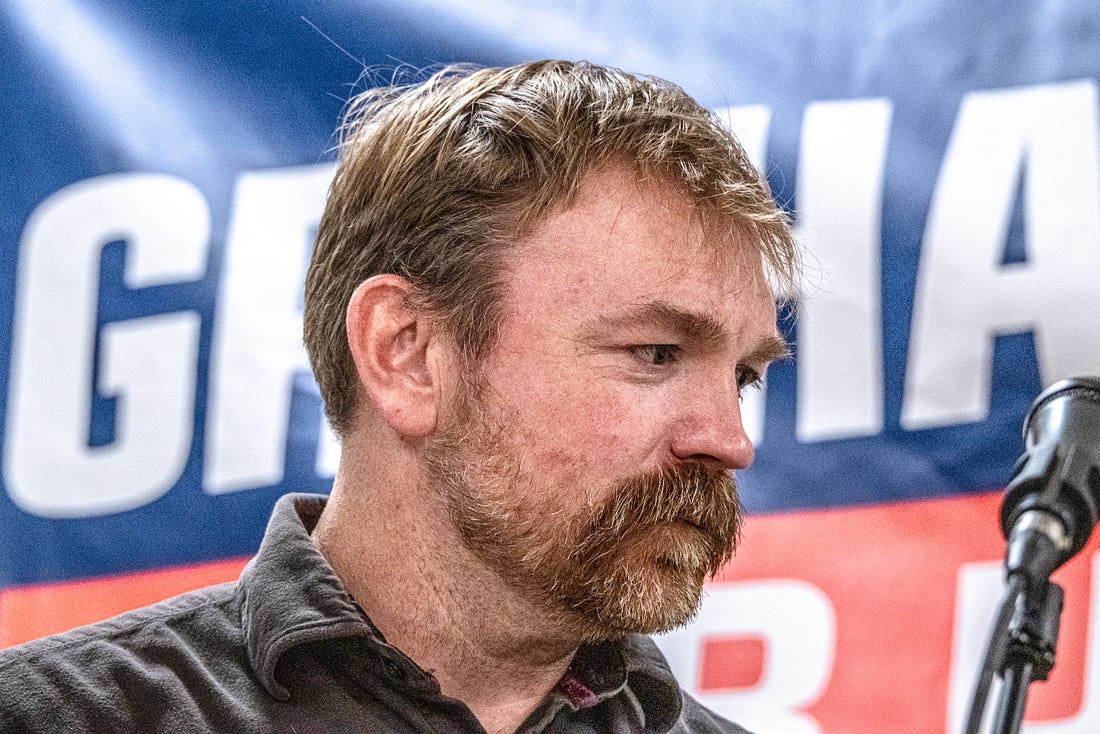

A Case Study in Recklessly Endangering the SenateGraham Platner had talent, but was selfish and reckless. And now it will take the type of politics he decried to clean up his mess.
Soccer? Never heard of it. Happy Tuesday. Join Bill Kristol and Ben Parker for Morning Shots Live today at 10:30 a.m. EDT on Substack and YouTube.
Platner and the Perils of Performative Populismby Sam Stein Having sparked his fair share of intrigue and passion, scandals and uncertainty, intraparty debates and bitter online feuding, Graham Platner finally delivered a universally shared sentiment: He will not end up in the United States Senate. In a new, devastating report from Politico on Monday, a woman who once dated Platner said he sexually assaulted her nearly five years ago. The details are both disturbing and well-documented. Her substantiation alone—Facebook messages supporting her account and corroboration from another ex-boyfriend whom she told about it—gives her account credibility. That Platner denied the accusation is far from convincing. At a certain point, the pattern of behavior becomes impossible to dismiss, even if the details are obscured by the fog of memory. He cannot win. The question now is not so much whether Platner goes, but how he goes. “We’re taking the time to reflect on the best path forward,” he said in a video posted right as the Politico article dropped. People relatively close to the campaign expect Platner not to try and brave this out, but to leave the race before July 13, giving the Maine Democratic Party the opportunity to pick a replacement. There is less than a week between now and then. What happens in that period is high-stakes. It’s not just control of the Senate at risk, but the equilibrium of the Democratic party and the larger message sent to voters about how seriously the party takes accusations of sexual assault. Serious reflection is in order. Platner unquestionably tapped into the Democratic party’s id in ways that other candidates for office have not. His burn-it-down populism resonated among an electorate desperate for confrontation, both with Donald Trump and their own establishment. He had a fluency on the trail and online that belied his inexperience in politics. But what did it say that the red flags got so obscured in the process? Why did the idea of better vetting get so casually dismissed? And how was it that political neophytism was treated as an asset and not a liability? Maybe having been through the ringer of an election is a value-add. Maybe having a political résumé should not be considered an opprobrium. These are questions Democrats are asking now, not just because they want explanations for the mess that the party is currently facing but because they are desperate to not blow these midterms. “As politics revolve more and more around who is the most effective communicator and who can connect with voters online, we will need to think about what we’re willing to accept in order to win,” Christina Reynolds, a longtime Democratic operative and former top official at EMILY’s List told me. “Elections are choices, of course, but there are a lot of critical elections out there right now, many with far less attention than this race, with candidates who don’t have these same issues and could win with a fraction of the attention and money aimed at this one Senate race.” Reynolds’s point is a retrospective one. Too much wish-casting was made for Platner. There was too little willingness to acknowledge that his flawed (now fatally flawed) candidacy was costing Democrats time, money and credibility. It was selfish of him to go on, knowing there were other stories out there, knowing that he was asking everyone invested in stamping out this type of behavior to swallow their pride. But that’s just one half of the puzzle Democrats have to solve. The other half involves what to do next in Maine. Switching candidates at this juncture is not a simple task. A chunk of that state’s electorate will look at what’s happening and find a conspiracy behind it. Others will recoil at the mere perception that the media or Democratic leadership are pushing Platner from the race. They will read the Politico story and declare it a he-said-she-said proposition. They will respond with some variation of: “Well, Republicans rallied around Donald Trump.” Can we get to a place where these people aren’t totally disillusioned? Frankly, who knows? That some of Platner’s biggest supporters have said he needs to drop out should provide some relief to Democrats. But not much. Hasan Piker may be fine with Platner leaving the race. He also may hate who ends up replacing him. But what are the other options? It was notable on Monday that just minutes after the Politico story was published, Sen. Susan Collins tweeted about how the Treasury Department, at her urging, would be reopening Taxpayer Assistance Centers in Augusta and Bangor. The most endangered Republican in the field was chugging along doing classically insider stuff—the type of politics so causally downplayed by those arguing that a wave would simply overwhelm the Republican party—while an epic, self-made clusterfuck engulfed her opponent. That’s the irony that Democrats are now dealing with. They are forced to engage in the insider politics that Platner ran so successfully against in order to save themselves from Platner’s implosion. They put it off too long. And now, they can’t any longer. “I have been on Team We Get Behind The Nominee Until It’s Too Much,” Rob Flaherty, Joe Biden and Kamala Harris’s top digital guru, told me. “And this is too much. He very transparently can’t win this election. He should get off the ballot.” But, Flaherty added, reflecting on his own experience in the 2024 campaign, “changing candidates mid-stream is difficult. As we saw, it doesn’t guarantee success. But in the last election Kamala Harris being the nominee materially saved a bunch of Senate seats. There were upsides even in losing. But you have to get him off the ballot.” “The situation is,” he observed, “unbelievably fucked.” AROUND THE BULWARK
Quick HitsMUM DEPORTATIONS: The Trump administration has been of two minds about its mass deportation agenda over its first year and a half. Most of the time, the order of the day has been “shock and awe” with spectacular displays of militarized might, which culminated in the extra-judicial execution of two Americans in Minnesota. But sometimes the administration has urged caution, instructing congressional Republicans not to use the term “mass deportation” (at least until the midterms) and signalling that 2025-style ICE invasions of major American cities were at an end. For now, apparently, cooler—though by no means more generous—heads have prevailed, Politico reports:
Just because ICE is maintaining a lower profile doesn’t mean that it’s less productive: So far the agency has reportedly been meeting its quota of 2,000 arrests per day. If they can keep up that pace, that’s 730,000 arrests per year—but that’s a big if. DIE DEUTSCHE NATO: Donald Trump enjoys few pastimes more than alienating Europe—with derogatory comments about their defense spending and burden sharing, with tariffs and trade wars, with unseemly coquettishness whenever Vladimir Putin is in the room,¹ and on and on. Now we’re starting to see the results. The Economist reports:
This is a world-historical gamble. In the past, when Germany has been the dominant military power in Europe, things haven’t turned out so well. But, hey, maybe the third time’s the charm? MEANWHILE, IN GAZA: Hamas announced that it was dissolving its administration of the Gaza Strip so that the technocratic administration created by Trump’s Board of Peace could take over. But believe it or not, it’s gotten kinda complicated, reports the Financial Times:
It’s hard to tell what Hamas’s message here is. It could be: We’re willing to give up control of the Gaza Strip to a Palestinian government but we won’t disarm—at least not while the Israelis are here. Or it could be: We officially renounce any responsibility for the welfare of the people we’ve systematically oppressed and abused for a generation, but we reserve the right to shoot at whomever we like. Unfortunately, that ambiguity counts as an improvement in the situation. SHUT UP AND TAKE THE W: The key to understanding Trump may be that he wants the appearance of corruption. He embraces it because, at least in his own mind, it makes everyone think he’s the center of the universe. This helps explain why he inserted himself into the Folarin Balogun red card controversy. In case you’ve been living under a rock: Balogun is the U.S. Men’s National Team’s star striker; he was given a questionable red card following the misapplication of video replay. Under World Cup guidelines, a red card leads to a one-match ban, but Balogun’s ban was suspended by FIFA the day before America’s game against Belgium. Trump reportedly called the president of FIFA to—depending on who you ask—either ask him what the rule around the one game suspension was or to ask him to review the play that led to the red card. FIFA insisted that they simply kicked the process to an independent review board, which determined that Balogun’s ban was not proper.² But people were outraged, and rightly so: Trump has no role to play here, his self-regard notwithstanding. The United States had an airtight case for appeal and the rest of the world was likely to lose their minds when the Balogun ban was (correctly) overturned. This sort of gloating is routinely self-defeating in a strategic sense. I couldn’t help but think back to the Jimmy Kimmel suspension in September of last year, following a tasteless crack about Charlie Kirk in the aftermath of his assassination. ABC suspended Kimmel out of fear of affiliate station backlash. After Trump and his FCC Chair Brendan Carr took victory laps celebrating their “win” over the late-night host, however, ABC not only reinstated Kimmel but when he made jokes about Melania Trump being a “happy widow,” the network rejected calls to punish him and boosted its case against the government effort to force an early license renewal. This is a running theme of Trump’s going back at least to the Bowe Bergdahl case, in which Trump’s remarks may have led to the dishonorably discharged soldier having his conviction set aside. But Trump’s lack of self-control is a feature, not a bug—at least, if you happen to be a narcissistic president who believes the world revolves around himself. —Sonny Bunch Cheap Shots
1
And, most recently, with dramatic appeals to FIFA to undo red cards given to American strikers before a match against Belgium.
2
The same rule was cited to suspend the ban Cristiano Ronaldo was supposed to serve at the start of this World Cup. You’re a free subscriber to The Bulwark—the largest pro-democracy news and analysis bundle on Substack. For unfettered access to all our newsletters and to access ad-free and member-only shows, become a paying subscriber.We’re going to send you a lot of content—newsletters and alerts for shows so you can read and watch on your schedule. Don’t care for so much email? You can update your personal email preferences as often as you like. To update the list of newsletters or alerts you received from The Bulwark, click here. Having trouble with something related to your account? Check out our constantly-updated FAQ, which likely has an answer for you.
|