
Hi, y’all. Welcome back to The Opposition. Democrats have spent much of this week debating what role the lefty streamer Hasan Piker should play in the party. If you haven’t heard of Piker before, good for you. That means you’re probably not spending an unhealthy amount of time on the internet. For the rest of us suckers, Piker’s growing influence within the Democratic party has been notable. But not everyone in the party thinks that Democrats should be cozying up to Piker, who has faced accusations of antisemitism. All that’s in today’s newsletter, below. If you find value in this kind of journalism—candid, searching, and careful—consider signing up for a Bulwark+ membership. There’s no better way to watch the primaries unfold, the general election campaigns get underway, and the jockeying for 2028 begin. Sign up today for a 20 percent discount: –Lauren P.S. – Check out our livestream tonight—with my colleagues JVL, Sam Stein, and Mark Hertling—after Donald Trump’s speech, on YouTube or Substack.
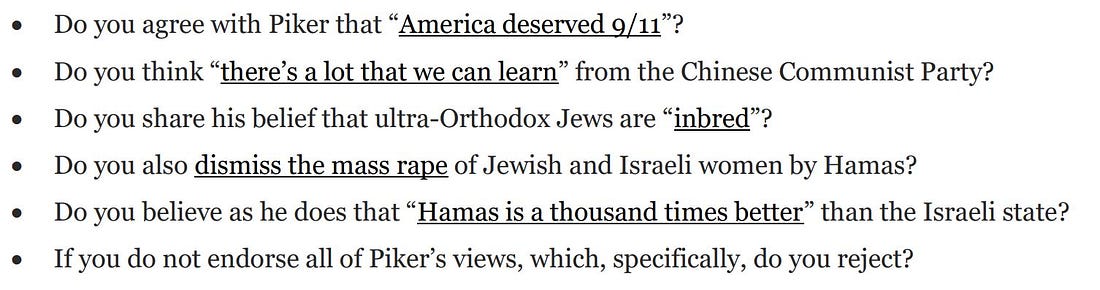
IN THE AFTERMATH of the 2024 election, a few points of agreement emerged among Democrats about where the party had gone wrong. Chief among them was that candidates simply had to ditch the litmus-test culture that had forced them to adopt positions outside the mainstream and led them to avoid uncomfortable or tricky interviews. Among those most vocally making the case were center-left organizations like Third Way, which urged the left flank of the party to recognize that a winning coalition requires tolerance of a wide range of viewpoints. They begged candidates to stop listening to advocacy groups and to refuse to fill out questionnaires and policy pledges that they argued had pushed the party too far left. For a good part of the past year, this consensus held. Democrats embraced a just-win-baby! mentality as they branched out to different podcasts and generally avoided the rhetorical and policy missteps that plagued them in 2024. But as the midterms near, the consensus is now being tested—and it’s Third Way doing the testing. The group has spent the past few weeks urging Democrats to distance themselves from Hasan Piker, the widely popular Twitch and YouTube streamer. The group’s president and press adviser, Jonathan Cowan and Lily Cohen, coauthored a Wall Street Journal opinion piece arguing that Piker’s “misogyny is indistinguishable from that of far-right influencers” and accusing him of antisemitism, saying that there was “no excuse for putting political tribalism before Jewish safety.” Things escalated last week when Abdul El-Sayed, who is running in the Democratic primary for Michigan’s open Senate seat, announced that Piker would campaign with him on college campuses. Then, this morning, Cowan sent a letter to El-Sayed warning that it would be a “stain” on his character if he followed through with the planned rallies, especially after a Michigan synagogue was attacked last month. The letter lists six questions in bullet points, asking El-Sayed to respond:
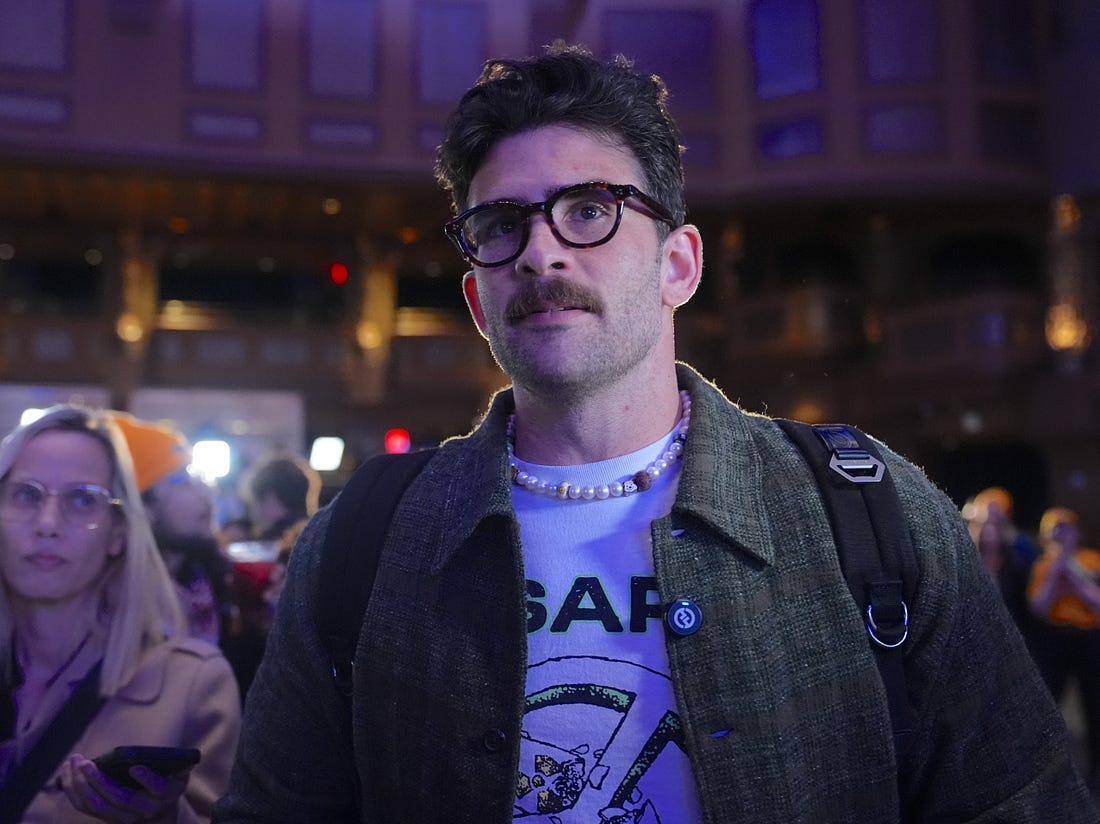
To Third Way’s critics, this was nothing short of abject hypocrisy—a group applying litmus tests to a liberal candidate after demanding that liberal groups drop the litmus tests they placed on mainstream candidates. “This is so clearly Third Way riling people up in a way that is so disingenuous,” said Amanda Litman, the cofounder of Run for Something, a progressive group that recruits and trains first-time candidates. She emphasized that part of politics is “having to deal with people who say crazy things you don’t agree with—and you have to work with them anyway.” “Who’s doing the scolding here?” she asked. “I thought we weren’t supposed to be canceling anyone anymore.” For Third Way, there is nothing inconsistent about its approach. In an interview, Cowan told me he draws a distinction between demanding policy purity from a candidate and moral clarity. He argued that if Piker had said offensive things about a minority group other than Jews, Democrats wouldn’t have hesitated to shun him. For El-Sayed to rally with Piker, he said, is as if George Bush had campaigned with David Duke instead of denouncing the KKK leader. Most significantly, Cowan made it clear that he’d rather accept some electoral risk than see the party show flexibility on this front. “If people really are arguing that the price of winning is becoming like a bigoted misogynist like Hasan Piker, then I’ll take not winning,” Cowan told me. “What is the point of reviving the Democratic party so it can compete in an age of right-wing populism, if the price of that is you mainstream bigoted, anti-American, misogynistic voices?” THAT PIKER HAS GAINED this type of lightning-rod status for Third Way is a testament to two things: the controversial statements he has made in the past and the size of the audience he has in the present. The 34-year-old operates one of the most-subscribed-to channels on Twitch, has sat for glossy magazine profiles, and has been generally viewed as the type of person who could be the “liberal Joe Rogan” that Democrats need—someone who would help the party regain cultural relevance and reach people who had tuned out its message. After all, he is an unapologetic progressive who lifts weights and pops Zyn and has millions of men (mostly young, mostly white) flocking to his stream to watch him game and analyze the news. Given the size and makeup of his audience, operatives have hustled to get their candidates booked on his stream. Recent guests include: Sen. Bernie Sanders (I-Vt.); Rep. Ro Khanna (D-Calif.); California gubernatorial candidate Tom Steyer; Chicago Mayor Brandon Johnson; former Obama adviser Ben Rhodes; Saikat Chakrabarti, who is running in the Democratic primary to replace retiring Rep. Nancy Pelosi in California; and El-Sayed. “If you want to run for office and engage in politics today, you have to go to where people are actually paying attention,” said Chakrabarti. “It’s ridiculous that the Democratic party is on the one hand saying ‘Let’s find our own Joe Rogan on the left,’ and then you have someone like Hasan—who is actively engaging the populations the Democratic party wants to engage with—and they’re not willing to go on his stream. I think it shows a disrespect for voters, and that’s, frankly, one of the reasons people keep not voting for Democrats.” But Piker has also said some offensive things. He can be crass and cocky and kind of annoying. He has hesitated to support Democrats he views as too moderate, including California Gov. Gavin Newsom and Joe Biden. And then there are his comments about Jews and the Middle East. He often blurs the line between thoughtful anti-Zionism and antisemitism—a problem that Democratic leaders have grown increasingly worried about as the situation in the Middle East grows more unstable. He has repeatedly referred to Orthodox Jews as “inbred.” In a 2019 video, he said that “America deserved 9/11.” He later said that his remark about 9/11 has been taken out of context from the larger point he was trying to make about the “boomerang effect” of the U.S.’s interventions in the Middle East. And he likewise maintains that his other critiques have been of the Israeli government and not the Jewish people. Despite the controversy—or because of it—millions of people turn to Piker for their news. As evidence of his draw, El-Sayed’s campaign told me that they’d received more signups—by far—for their rally with Piker than for any of their other events. THE DEBATE AROUND PIKER goes deeper than clashes over campaign tactics and media strategy; it involves questions about what is required of the Democratic party in this political moment to keep Donald Trump’s authoritarian project at bay. If democracy really is at risk, do Democrats have the luxury of kicking someone like Piker out of their tent, or does it require making political alliances with people who have said bad things on the internet? Alternatively, is staying away from Piker an important part of guarding the party’s boundaries, something that has to be done even when the stakes for democracy are existential? For a while, the party seemed to have clear answers to these questions: that, generally speaking, the pursuit of power did not require purity or perfection; and that the party needed to go everywhere and talk to everyone. But, as is often the case, the Democratic political class also is invested in winning intraparty ideological wars. And sometimes that has come at the cost of winning elections. That might not be the case in 2026. But there’s also a nonzero chance that this soon devolves into escalating calls for cancellation. “The tent already includes [Piker],” Usamah Andrabi, a spokesperson for the progressive group Justice Democrats told me when asked about Third Way’s response to Piker. “I think the question is actually whether our tent should continue to be big enough for a very vocal minority of corporatists and right-wing hawks who are still trying to keep this party under the grips of corporate interests and war-hawk lobbies like AIPAC.” Ladies and gentlemen . . . the Democrats! 🫏 Donkey Business:— On a more lighthearted note, Illinois Gov. JB Pritzker and Connecticut Gov. Ned Lamont have a friendly bet going ahead of the NCAA Men’s Final Four matchup between Illinois and UConn this Saturday. Lamont is putting New Haven pizza (yum) and Pez candy (gross) on the line, while Pritzker offered up Chicago-based Eli’s Cheesecake and Illinois barbecue. — California Democrats are starting to get anxious that the large number of Democratic candidates running to replace Gov. Gavin Newsom could split the vote and wind up giving the governorship to Republicans. Because California uses a “jungle primary” system, voters can select any candidate regardless of party. The top two vote-getters will advance to the general election. Although there’s still plenty of time for the field to narrow before the June 2 primary, some polls show Republican candidates in the top two spots. Rusty Hicks, chair of the California Democratic Party, has publicly urged lower-tier candidates to drop out. But as Politico reports, his pleas have “been met with backlash and accusations of racism.” All eyes are on influential party leaders—including Newsom, Rep. Nancy Pelosi, and Sen. Alex Padilla—to see if they endorse a candidate in an effort to shrink the field before it’s too late. My open tabs:— They’re the Kings of ‘Seinfeld’ Trivia—and They Watch Literally Nothing Else on TV — One of the Democrats’ Generational Battles: He’s 76, His Opponent Is 31 You’re a free subscriber to The Bulwark—the largest pro-democracy news and analysis bundle on Substack. For unfettered access to all our newsletters and to access ad-free and member-only shows, become a paying subscriber.We’re going to send you a lot of content—newsletters and alerts for shows so you can read and watch on your schedule. Don’t care for so much email? You can update your personal email preferences as often as you like. To update the list of newsletters or alerts you received from The Bulwark, click here. Having trouble with something related to your account? Check out our constantly-updated FAQ, which likely has an answer for you.
|