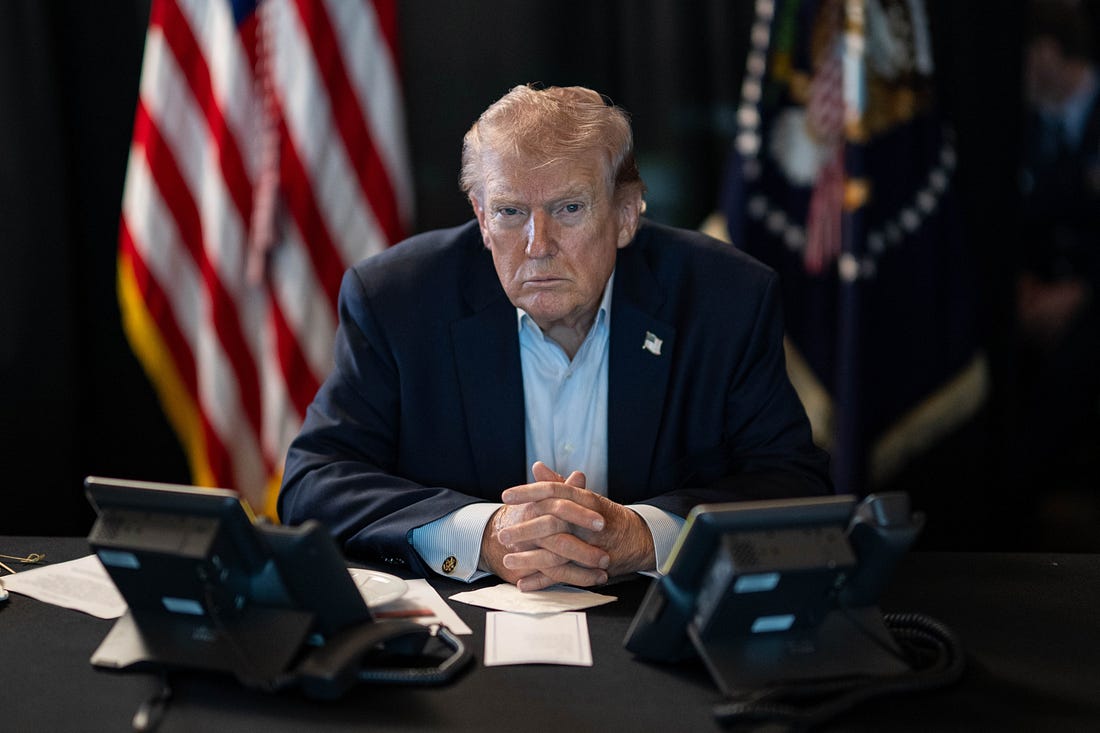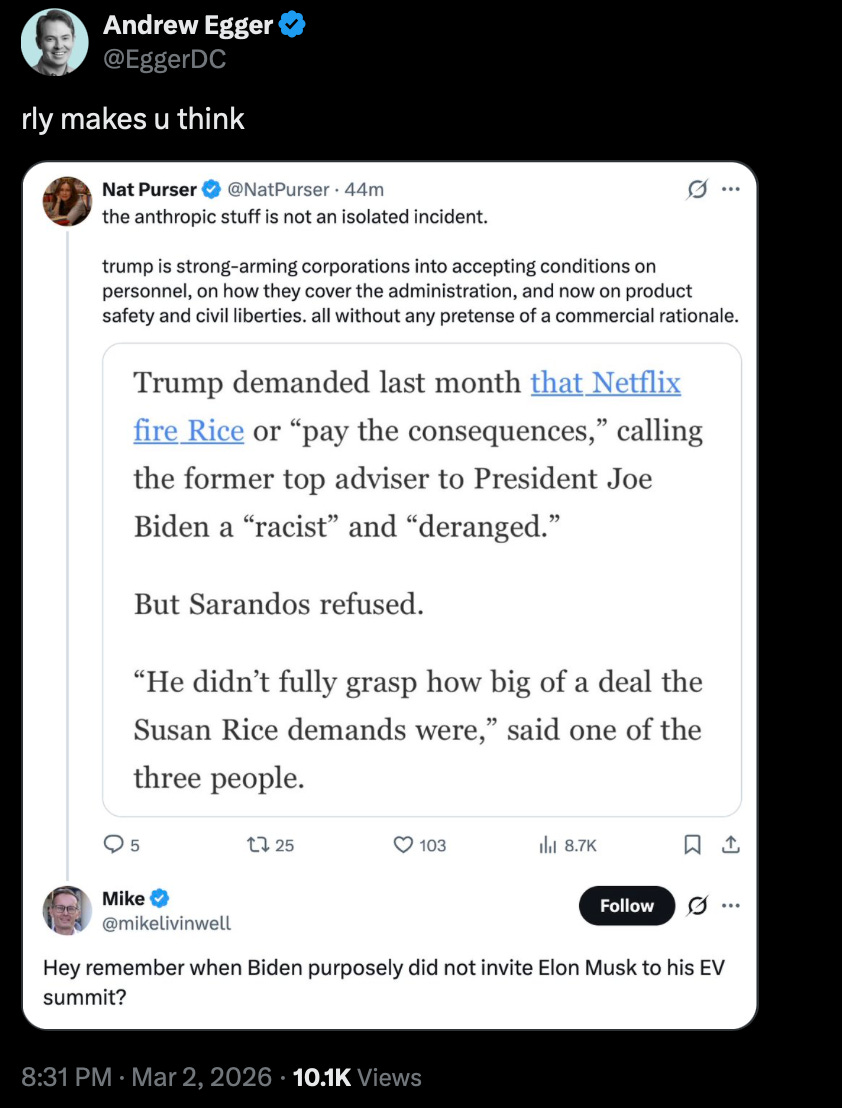
A vignette from the end of the U.S.-led global order, per Reuters:
Happy Tuesday.
Why War? Why Now?by William Kristol Why did we go to war four days ago? And why are we going to continue this war, apparently for weeks or longer? The Trump administration can’t answer either question. That’s why some administration surrogates are trying to tell us we’re not at war. Yesterday Kasie Hunt of CNN posed a sensible question to Republican Sen. Markwayne Mullin, who serves on the Armed Services Committee and who has been acting as an administration surrogate over the last few days: “Did the president not run on not starting a war with Iran?” Sen. Mullin deflected: “This isn’t a war.” You know the administration’s defenders are in trouble when they resort to this kind of denial of reality. Secretary of Defense Pete Hegseth had undermined this talking point a few hours earlier, acknowledging that we are in fact at war: “We didn’t start this war, but under President Trump, we are finishing it.” So yes, we are at war. To deny this is disrespectful both to the American public, who have eyes to see what is happening, and to our servicemen and servicewomen, whom the administration has ordered into harm’s way. Will Sen. Mullin explain to the families of the service members who have died that their loved ones were not fighting in a war? Why did we go to war now? The administration hasn’t offered a coherent explanation. Over the weekend, President Trump suggested several purposes and backed away from some, leaving confusion in his wake. His aides tried to clean things up yesterday, having Trump read military “objectives” from a teleprompter at the White House. But none of the objectives—destroying Iran’s missile capabilities and its navy, ensuring Iran can’t obtain a nuclear weapon or support terrorism—explain why we had to go to war now. Nor do they explain why we are engaged in such an open-ended and massive military campaign. Yesterday, President Trump sent the formal notice to Congress required by the War Powers Act. He explained, “Despite my Administration’s repeated efforts to achieve a diplomatic solution to Iran’s malign behavior, the threat to the United States and its allies and partners became untenable.” “The threat became . . . untenable.” There’s no claim of self-defense. There’s no claim of imminent danger. Rather, the claim is that we were facing an allegedly untenable threat. But of course if the administration saw the threat becoming untenable, it could have done what the Constitution requires—gone to Congress, explained the situation, and sought authorization for going to war. Trump’s secretary of state, Marco Rubio, tried to help out his boss yesterday by arguing that the threat really was imminent, and that it required a preemptive attack:
But last June, Israel was at war with Iran for almost two weeks before the United States came in briefly to help finish the job. During that time there were major Iranian attacks against Israel—but only very minor, scattered attacks on U.S. assets in the region. Presumably the administration, which was, after all, in discussions with Iran last week, could have warned Iran not to attack our bases if Israel attacked. Iran would have had plenty of incentives to heed such a warning. Instead the administration chose a pre-emptive and unauthorized war for which it has offered no coherent rationale. And it now has no sound argument for why this war must be extended. The military objectives Trump mentioned have mostly been achieved, insofar as they can be. The human toll and the geopolitical and economic costs mount each day. And six American service members have died. Why should more be put in harm’s way? The answer is simple: Congress should not give this administration a blank and open-ended check to continue to wage a massive, risky, and unconstitutional war. If there’s ever a post-Trump repair of the guardrails around executive power, what should be done about the president’s war powers? And how did we get to where we are now? Share your thoughts in the comments. Who’s in Charge Around Here?by Andrew Egger and Benjamin Parker As it hunted around yesterday for a plausible-sounding rationale for launching its attack against Iran, Republicans in the White House and Congress admitted something astonishing: It was Israel, not America, that picked the moment of attack. Yesterday, the New York Times reported that Trump had told the podcaster Tucker Carlson, who opposed military action in Iran, that he had “no choice but to join a strike” that Israel was going to launch no matter what. That might have been brushed off as a self-serving leak from Carlson himself—if it weren’t for the fact that Secretary of State Marco Rubio made the same case to reporters in the Capitol yesterday afternoon, as Bill quoted above: “We knew that if we didn’t preemptively go after [Iran] before [Israel] launched those attacks, we would suffer higher casualties,” Rubio said. “We were not going to sit there and absorb a body blow before we responded,” he added. Israel, House Speaker Mike Johnson told reporters separately, had been determined to strike Iran “with or without the U.S.,” which meant Trump and his administration “had a very difficult decision to make.” This isn’t to say the White House was dragged into the conflict kicking and screaming. Rubio made it clear in his remarks that America knew it would have to strike Iran sometime soon, arguing the regime was on track to cross a “line of immunity” in terms of its short-range missile and drone stockpiles within “about a year or a year and a half.” “This had to happen,” Rubio emphasized, “no matter what.” Still, the frank acknowledgement that Israel had set the terms for this engagement was remarkable. Sen. Mark Warner (D-Va.), the top Democrat on the Senate Intelligence Committee, suggested that Israel was wagging the dog: “This is still a war of choice that has been acknowledged by others that was dictated by Israel’s goals and timeline,” he said at the Capitol yesterday. Last year, after America’s and Israel’s attacks against Iran’s nuclear program, Trump successfully brought the conflict screeching to a halt by publicly browbeating Israel and Iran to stop retaliating against one another, going so far as to send an all-caps Truth Social warning to Israel: “ISRAEL. DO NOT DROP THOSE BOMBS. IF YOU DO IT IS A MAJOR VIOLATION. BRING YOUR PILOTS HOME, NOW!” Apparently, Trump didn’t think he had the same sort of clout this time around. One of the only true consistencies of Trump’s foreign policy—besides tariffs—has been his Putin-like insistence on being treated with what he considers the appropriate deference and respect internationally. He’s made it very clear to our allies, like Canada and Denmark, as well as smaller countries like Venezuela, that America is a major country that can do whatever it wants to minor countries. (He treats China and Russia as members of the same great-powers club.) The one exception appears to be Israel, which, despite not being a treaty ally of the United States and being one of the smallest countries on the planet, can nonetheless—at least in the telling of the administration—drag our globe-striding superpower into war. Alliances are tricky things to manage. Much of America’s foreign policy since World War II has been about balancing support for friendly countries against America’s need to, internationally speaking, do its own thing. (Not to relive the past, but one recent president who actually did a pretty good job supporting Israel while ensuring it didn’t have carte blanche from the United States was . . . Joe Biden.) Of course, the administration’s telling is wrong. The United States isn’t bound by Israel’s foreign policy any more than it is by France’s or Australia’s. And while suggesting it was all Israel’s idea may make it a bit easier to argue that America was facing an imminent threat under any circumstances, the White House may be opening themselves up by saying so to a barrage of attacks from the anti-Israel parts of its own base. “We need to have a serious conversation about what the fuck is happening to this country,” former Rep. Marjorie Taylor Greene said yesterday, “and who in the hell are these decisions being made for, and who is making these decisions.” AROUND THE BULWARK
Quick HitsJUSTICE FOR BIGLAW: Last year, as part of his revenge crusade, Donald Trump targeted some of the nation’s top law firms, revoking security clearances for their employees and canceling their government contracts via a blizzard of executive orders. Some of these firms thought the safest bet would be surrender, pledging hundreds of millions of dollars of pro bono legal services to causes the president favored. But others fought back, suing to block Trump’s vindictive executive orders and piling up a series of legal victories. Now, the fighters have seemingly won for good. The Wall Street Journal reported yesterday that the Trump administration plans to drop its appeals of lower-court rulings that struck down his actions against the firms Jenner & Block, Perkins Coie, Susman Godfrey, and WilmerHale. As the Journal notes, Trump’s loss isn’t complete: “The executive orders nonetheless put a lasting chill on the industry. . . . Many of the same firms that took a leading role opposing the Trump administration in court during his first term have shied away from taking on pro bono cases adverse to the government.” Still, the fact that the firms that fought Trump have triumphed—while the ones who bent the knee are still on the hook for their pro-bono contributions—is a reminder of one of the central lessons of Trump 2.0: When elite institutions have tried to comply in advance, it’s usually only encouraged him to press them even harder. But when they’ve hit back, they’ve frequently discovered he wasn’t able to back up his threats as well as they’d feared. WITH FRIENDS LIKE THESE: It’s fair to say at this point that the administration seems to be reacting to the foreseeable consequences of its decision to attack Iran, rather than anticipating some of the more obvious outcomes. On Monday, the State Department issued a “DEPART NOW VIA COMMERCIAL MEANS” advisory for U.S. citizens living in fourteen Middle Eastern countries. The notion that roughly 300,000 people would get up and go overnight seems almost Biblical. And, sure enough, within a few hours, it became even clearer that the Trump foreign policy apparatus was winging it. In a post from its official X account, the U.S. Embassy in Jerusalem alerted those Americans trying to leave Israel (an act that the State Department had just encouraged) that it was “not in a position at this time to evacuate or directly assist” them. It said they should “make [their] own security plans” while noting that the “Israeli Ministry of Tourism has begun operating shuttles to the Taba Border Crossing as of March 2.” As a measure of aid, the embassy noted that in order to be added “to the passenger list for a shuttle,” Americans would need to “register via the Ministry’s evacuation form.” But even then, no assurances! “The U.S. Embassy cannot make any recommendation (for or against) the Ministry of Tourism’s shuttle,” the note read. “If you choose to avail yourself of this option to depart, the U.S. government cannot guarantee your safety.” —Sam Stein KASH IS MAYBE NOT KING: What a month for our beleaguered FBI director. After enduring criticism for concocting a rationale to go watch the Olympics in person in Milan—and then partying with the men’s hockey team after they won gold—Kash Patel returned home only to start another controversy. Last week, he fired a dozen agents and staffers who had played a role in the investigation of Donald Trump for housing (and refusing to turn over) classified documents after losing the presidency in 2020. That was bad enough. There was no evidence the agents had done anything improper in the Trump investigation. But it gets worse. Per Carol Leoning at MS NOW, the agents Patel targeted were part of “an elite counter espionage unit that investigates threats from foreign adversaries and specializes in Iran,” known as CI-12. As Leoning writes, the timing of the firing (coming literally days before Trump decided to bomb Iran) was unfortunate at best.
Maybe the only upside is that now those agents can’t be ordered to help with mass deportations. —Sam Stein Cheap Shots
You’re a free subscriber to The Bulwark—the largest pro-democracy news and analysis bundle on Substack. For unfettered access to all our newsletters and to access ad-free and member-only shows, become a paying subscriber.We’re going to send you a lot of content—newsletters and alerts for shows so you can read and watch on your schedule. Don’t care for so much email? You can update your personal email preferences as often as you like. To update the list of newsletters or alerts you received from The Bulwark, click here. Having trouble with something related to your account? Check out our constantly-updated FAQ, which likely has an answer for you.
|
What Is the Point of This War?
March 03, 2026
0