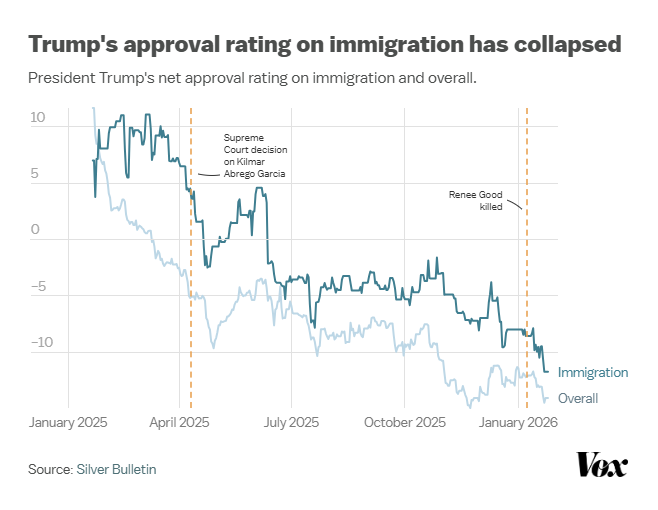
Hi readers, happy Monday! It's a new month — good riddance to the last one. This morning, I'm turning to my colleague Eric Levitz, whose new story digs into how Americans feel about immigration right now. At one point, it was one of President Donald Trump's strongest issues. A little over a year since he returned to office, Trump's approval ratings on the topic have collapsed (though not quite as far as his overall approval has). In today's edition, Eric answers the question: How did Trump manage to turn his biggest political asset into a liability? Plus: Weaponizing foreign aid, a sardine boom, and the Washington Post. |
|
|
Brendan Smialowski / AFP via Getty Images |
|
|
When President Donald Trump launched his deportation campaign last January, he had the American public at his back. Under Joe Biden, unauthorized border crossings had soared to record levels — and threw America into a nativist mood. In November 2024, a CBS News/You Gov poll found 57 percent of Americans expressing support for "a national program to find and deport all immigrants who are in the U.S. illegally," while 73 percent said that the next president should make deportations a priority. The Trump White House was happy to oblige. And during its first months in office, the public seemed pleased with its efforts. In early 2025, voters approved of Trump's handling of immigration by as much as 12 points, while favoring his "program to deport immigrants illegally in the US" by 16. Immigration was the foundation of Trump's political strength — the issue where he consistently enjoyed the trust of a supermajority of Americans. And he squandered it within a year. Once, the phrase "Trump's immigration policy" evoked images of order in the American imagination: a wall ringing the nation's borders, migrant panhandlers and criminals airbrushed from city streets. Today, those words conjure much different pictures — of masked paramilitaries pepper-spraying protesters, breaking into people's homes, tearing parents from their crying children, and pumping bullets into American citizens. Voters do not like what they see. Trump's approval on immigration is now underwater by 12 points. Americans disapprove of his "deportation program" by 8 points and say ICE is making communities "less safe" rather than "more safe" by 21. Not long ago, "Abolish ICE" was among the most politically toxic propositions in American politics. Now, 46 percent of voters — including one-fifth of Republicans — support the idea, according to a recent YouGov poll. |
Until this week, the White House evinced little concern for its immigration agenda's collapsing support. When an ICE agent needlessly shot a 37-year-old mother to death in Minneapolis in early January, the Trump administration immediately rallied to the shooter's defense. When Border Patrol agents were caught on video Saturday firing 10 bullets into the back of a protester, the Department of Homeland Security swiftly smeared the victim as a domestic terrorist, effectively asking Americans to trust its word over their lying eyes. Even conservatives struggled to stomach that last act of depravity. The administration's handling of Alex Pretti's killing provoked rebukes from Republican senators, right-wing magazines, and the NRA. Faced with a backlash so broad and overwhelming, Trump finally decided to change course, however minutely. In recent days, he demoted his hardline Border Patrol Commander Gregory Bovino, extended an olive branch to Minnesota Gov. Tim Walz, discussed Democratic demands for DHS reform with Senate Minority Leader Chuck Schumer, and suggested that Pretti's death would receive a thorough investigation (although, there are signs this may not actually be the case). Given the scale of ICE and CPB's lawlessness, it would be generous to call these half-measures. The administration still appears staunchly opposed to reforms that would actually ensure its deportation forces' professionalism and legal accountability. It is still eager to use immigration policy as a tool for terrorizing ethnic minorities and punishing the administration's political adversaries. By indulging these radical impulses, Trump has achieved an extraordinary feat of political self-sabotage: He has managed to turn his greatest source of political vitality into a vulnerability — and done so despite successfully addressing the electorate's chief complaint on that issue as of 2024. You can read Eric's full story on the Vox site here. |
|
|
⮕ Keep tabs Weaponizing aid: Under the Trump administration's expanded "global gag rule," writes Vox's Sara Herschander, America's culture wars are killing people overseas. [Vox] Sardine boom: Vox's Kyndall Cunningham explains why tinned fish is everywhere now — and how Gen Z is turning it into more than just a snack. [Vox] The new propagandists: How right-wing influencers like Nick Shirley are churning out "slopaganda." [The Verge]
Save the Post: At the Washington Post, journalists are pleading with Jeff Bezos to spare the newspaper. [NPR]
|
|
|
The Vox Membership program is getting even better with access to Vox's Patreon, where members can unlock exclusive videos, livestreams, and chats with our newsroom. Become a Vox Member to get access to it all. |
|
|
| What if we stopped shopping? |
Fed up with consumerism, Mia Westrap went a whole year without buying unnecessary stuff. She went viral, and so did her goal. Now, the Buy Nothing movement is fighting back against mindless consumption by doing...nothing. |
|
|
The Winter Olympics start on Friday. If you want to get up to speed on some of the storylines to watch, Kathryn Xu's figure skating coverage over at Defector, including her stories about Amber Glenn and the "Quad God" Ilia Malinin, is a great place to start. |
|
|
Today's edition was produced and edited by me, Cameron Peters. Thanks for reading! |
|
|
Are you enjoying the Today, Explained newsletter? Forward it to a friend; they can sign up here. And as always, we want to know what you think. Let us know by filling out this form or just replying to this email. |
|
|
|