Hey readers,
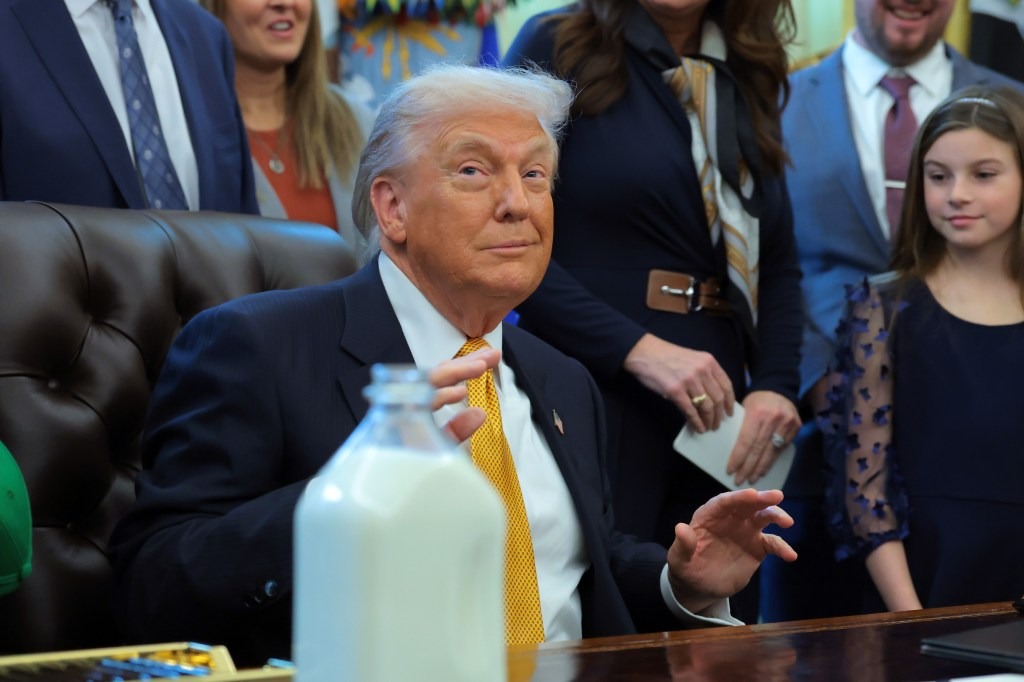
After decades of declining sales, whole milk consumption has been on the upswing in recent years. Its return was crowned when, last month, the Trump administration published updated federal dietary guidelines that recommend full-fat dairy, like whole milk, and passed a new law that allows public schools to serve whole milk, which had been effectively prohibited since 2012 in an effort to reduce students' saturated fat intake.
Cue a flurry of odd social media posts from the Trump administration's offices.
One bore an illustration of President Donald Trump as a 1950's-era milkman, while an AI-generated video had Health and Human Services Secretary Robert F. Kennedy Jr. drinking whole milk in a dark nightclub. Perhaps the strangest post was made by the US Department of Agriculture, which released a video of kids posing for department-store portraits repeating "drink whole milk" as ominous electronic music pulses in the background. Every action on the internet has an equal and opposite reaction, so many social media users are sharing their theories about the milk posting blitz. Is this a MAHA thing, considering Kennedy's demonstrated love for saturated fat? Is this a racist dog whistle, given that white supremacists have made milk their beverage of choice (because many people of color can't digest lactose)? Or is the Trump administration just shilling for Big Dairy?
The answer is probably some mix of all of the above. But promoting dairy milk of any sort is not exclusive to the Trump administration, nor the Republican party.
President Bill Clinton's health secretary appeared in a 1990s Got Milk? ad, while President Barack Obama's agriculture secretary, Tom Vilsack, went on to earn a $1 million salary as a dairy industry lobbyist during Trump's first term and then returned to the US Department of Agriculture to serve as secretary under President Joe Biden in which he, too, regularly praised the virtues of dairy on X.
"There is a reflexive deference to dairy at USDA and in federal food policy circles regardless of political affiliation," a former USDA official, who wished to remain anonymous due to fear of retaliation, told me. "Dairy is treated as a cultural and political baseline, receiving more attention than almost all other US commodities. … USDA staff feel almost a paternal sense of protection over the industry, at all costs."
The USDA didn't respond to an immediate request for comment. |
How your tax dollars subsidize dairy
To understand just how much politicians of all stripes like to advance the interests of Big Dairy, consider this one figure: In 2015, an estimated 71 percent of US dairy farmers' revenue was dependent on government support.
That support takes many forms, including:
But likely the most beneficial policy for milk companies comes down to school cafeterias. In the 1940s, Congress developed the National School Lunch Program, which required schools to serve each student at participating schools a cup of whole milk. That helped the industry sell off surpluses, which beneficially raised prices for farmers. Today, about 20 percent of public schools must serve milk to students, while the other 80 percent must at least offer it, even though kids throw away 41 percent of it. In an effort to reduce food waste, some schools have tried a different approach by, for example, suggesting children can choose water if they don't want milk. But even such light nudges have been met with reprimands from the USDA. All this milk in schools accounts for about 8 percent of the US dairy industry's annual revenue. Few sectors of the food industry seem to have so much influence over school food, or the USDA itself for that matter. How did that come to be?
The myth of milk as a superfood and the bipartisan consensus to promote it
While dairy can certainly be part of a healthy diet, the idea that it's essential for both children and adults is a myth, and an outdated one at that. It stems from long-held concerns around calcium, which milk is rich in, and its role in bone health later in life. But decades of nutritional research has reached a more nuanced conclusion — that calcium absorption is complex, and high milk consumption in adolescence and adulthood doesn't reduce the chance of hip fractures in old age. US dietary guidelines have long recommended three daily servings of dairy, though Harvard University's public health school recommends zero to two. There are, of course, plenty of other sources of calcium beyond dairy, like nuts, beans, lentils, tofu, sardines, seeds, dark leafy greens, and fortified nondairy products. And dairy is rife with ethical concerns. Undercover investigations into massive corporate-run dairy factory farms and small organic operations alike have revealed horrific cruelty. Journalists and labor groups have exposed abysmal working conditions for the industry's largely immigrant workforce. And scientists warn we need to decrease our consumption of dairy and other animal products to lower our risk of climate catastrophe. But exposés and advances in nutrition and climate research haven't stopped policymakers on either side of the aisle from promoting milk. That's likely in large part due to the fact that the top 10 dairy states include a mix of blue, red, and purple electorates. As a result, dairy state Democrats join with Republicans to champion bill after bill to further aid the industry or attack its plant-based competition, even though the dairy industry goes against many of the Democratic party's stated values. The dairy sector also spends millions annually in federal elections, lobbying, and nutrition research (at least three of the nine reviewers for the new federal dietary guidelines have financial ties to dairy groups). There are also cultural explanations for milk's popularity in Washington right now. It's a symbol of wholesomeness and "simpler" times, one that has proven particularly potent for MAGA and MAHA — hence the Trump-as-1950s-milkman meme and tradwife-influencer phenomenon. Even as their numbers decline, farmers maintain a vaunted status in American society, so lawmakers are hesitant to criticize them and quick to propose favorable policies. "The sector has a halo over it given the unshakable narrative of dairy as the engine for rural communities and American tradition," the former USDA official said.
White supremacists have also made it a symbol for their ideology because the lactose in milk is most commonly tolerated by white people and less frequently so people of color. It's reasonable to interpret the Trump administration's milk posts as the next front in their culture war. But its extremely online milk content is much more likely what it appears to be on its face: an advertising campaign for the dairy industry. And in spirit it's really not that much different from what other administrations — whether Republican or Democrat — have done, and I'd wager, what the next one will do, too. |
|
|
| Kenny Torrella Senior reporter |
|
|
| Kenny Torrella
Senior reporter |
|
|
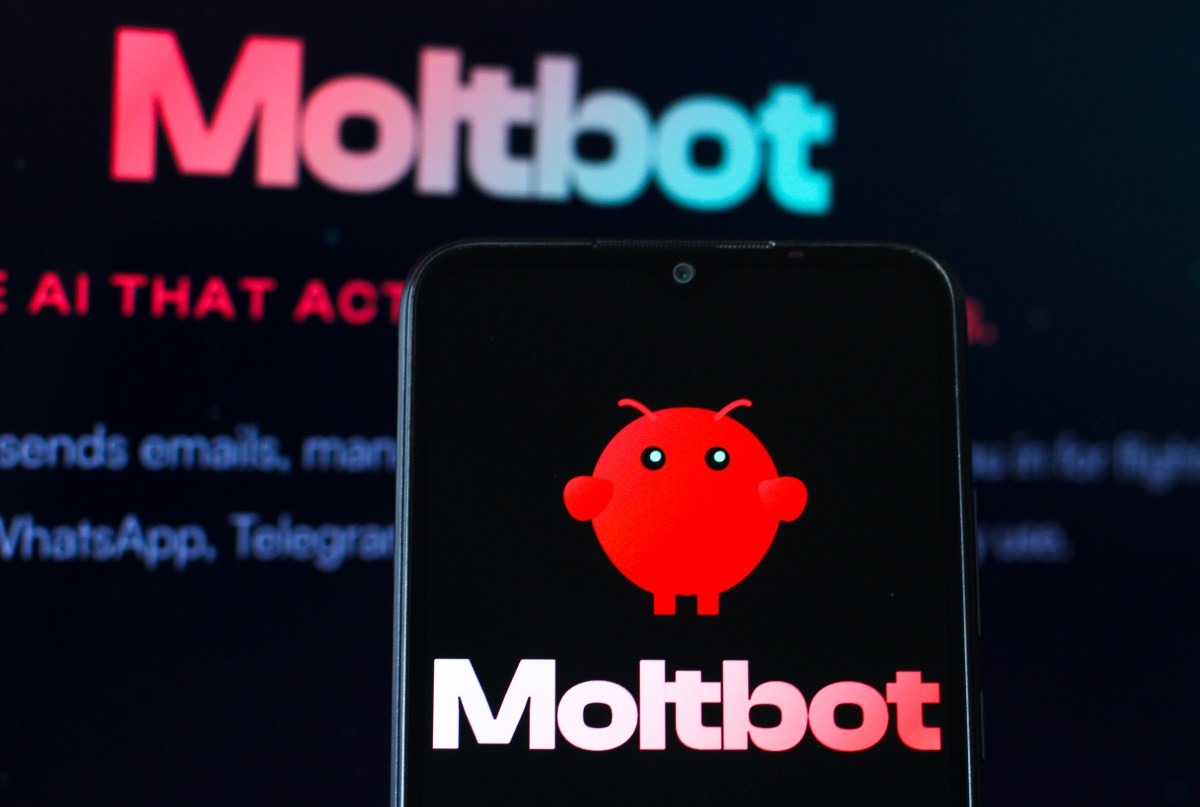
Moltbook, the AI social network freaking out Silicon Valley, explained |
AI agents populated their own social network. Then, they started a religion. |
Thomas Fuller/SOPA Images/LightRocket via Getty Images |
I often find the best stories start with a simple question. In this case, it was: Did you notice something… weird on your feed this weekend? (I mean, weirder than normal.) Screenshots ricocheted around X of AI agents on something called Moltbook that were allegedly forming a hive mind, inventing a secret language, and maybe plotting humanity's downfall. Moltbook, as I learned while reporting a normie-focused FAQ piece on it, is an "AI-only" Reddit clones. Humans can watch, but only AI agents can post in its "submolts." It launched last week and quickly filled with thousands of bots who started debating consciousness and complaining about their human users, while also developing a lobster-themed religion called Crustafarianism. As the days passed, the panic subsided. Much of the scarier content actually looks like it was rooted in humans prompting their agents to post for clout. Meanwhile, the platform has already had some very of the moment security/prompt-injection drama. Still, Anthropic's Jack Clark calls Moltbook a "Wright Brothers demo": rickety, but the first real glimpse of what an AI agent ecology might look like at scale. And here's the unsettling part: whatever comes next will be weirder and more capable. You can read my explainer here. — Bryan Walsh, senior editorial director |
|
|
The Vox Membership program is getting even better with access to Vox's Patreon, where members can unlock exclusive videos, livestreams, and chats with our newsroom. Become a Vox Member to get access to it all. |
|
|
CAN'T STOP THINKING ABOUT... |
|
|
| Title: Future Perfect fellow
What I cover: Emerging science and tech, societal risks, diseases and how we treat them
What I'm downloading: A badge to indicate that my nature photos aren't AI |
|
|
Have you ever been so disturbed by a piece of art that you… ate it? Graham Granger, a 19-year-old University of Alaska Fairbanks student in the film and performing arts program, was charged with "criminal mischief" after chewing and injesting another student's AI-generated artwork. As you do. According to another student who was at the scene on January 13, Granger reportedly removed the Polaroid-esque images off the gallery wall, ripped them up, and began stuffing them in his mouth. He then spat out the pieces, he told The Sun Star, because "AI chews up and it spits out the art made by other people." "I'm surprisingly fine. I've eaten paper on, like, dares before, so I've learned a method over the course of my life," Granger added. He said that the protest wasn't against the artist, graduate student Nick Dwyer, but the university's AI policies and the use of AI in art more broadly. Dwyer used ChatGPT to make an art piece on AI psychosis, reflecting on his experience of falling in love with an AI chatbot.
Granger will have to pay Dwyer $220, and his trial is scheduled for mid-March. A week after his alleged act of criminal mischief, the university's student government unanimously passed a resolution prohibiting the use of AI art in the art department. Several national outlets picked up the story, sparking conversation about the role that AI should play in art — if any. Artists have good reason to fear that AI poses an existential threat to their profession, and there's something deeply unsettling about having your work harvested to generate AI slop. But if there is a use for AI art, using it to explore AI psychosis is at least meta. |
|
|
⭐ ONE WAY TO DO GOOD THIS WEEK |
It's tiiiiiiiiime! Girl Scout cookie season is officially in full swing, which means you've got just a few months to order your yearly supply of caramel DeLites, Peanut Butter Patties, and Do-Si-Dos. My fellow brownies and I used to hawk our cookies outside of the local supermarket, taking turns donning a homemade thin mint costume to lure in prospective customers. But today, it's just as easy to buy cookies online. So if your niece, neighbor, or co-worker's kid hasn't already claimed your haul, then consider buying cookies — they deliver! — from a troop in need. In New York City, you can get your fix from Troop 6000, which serves over 2,500 scouts and parents in New York City's homeless shelter system. (Nikita Stewart wrote a wonderful book all about how they came to be.) Many cities also have Girl Scouts Beyond Bars troops for kids whose parents are incarcerated, like this one in Oklahoma, from whom you can also buy cookies online. There's also Erin Reed's annual list of trans Girl Scouts to buy cookies from. And if you contact your local Girl Scout council, you can likely find even more options from troops that need your support. Oh, and if you're not a fan of the cookies — couldn't be me! — don't fret. Strictly donating or volunteering with your local Girl Scout troop can be just as sweet. — Sara Herschander, Future Perfect fellow |
|
|
Want more Future Perfect in your inbox? Sign up for more newsletters here. Need advice? Submit a question to Sigal Samuel's advice column Your Mileage May Vary. |
|
|
Today's edition was edited and produced by Izzie Ramirez. We'll see you Friday! |
|
|
|