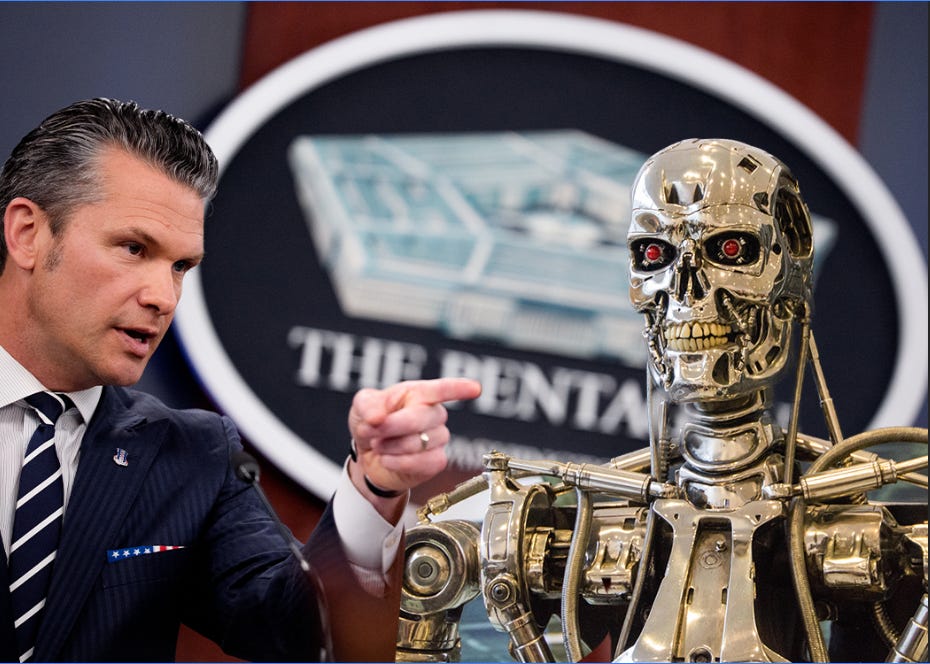
AI Death Machines. No Human Oversight. What Could Go Wrong?Pete Hegseth is trying to bully Anthropic out of objecting to “lethal autonomous weapons systems” and mass surveillance.
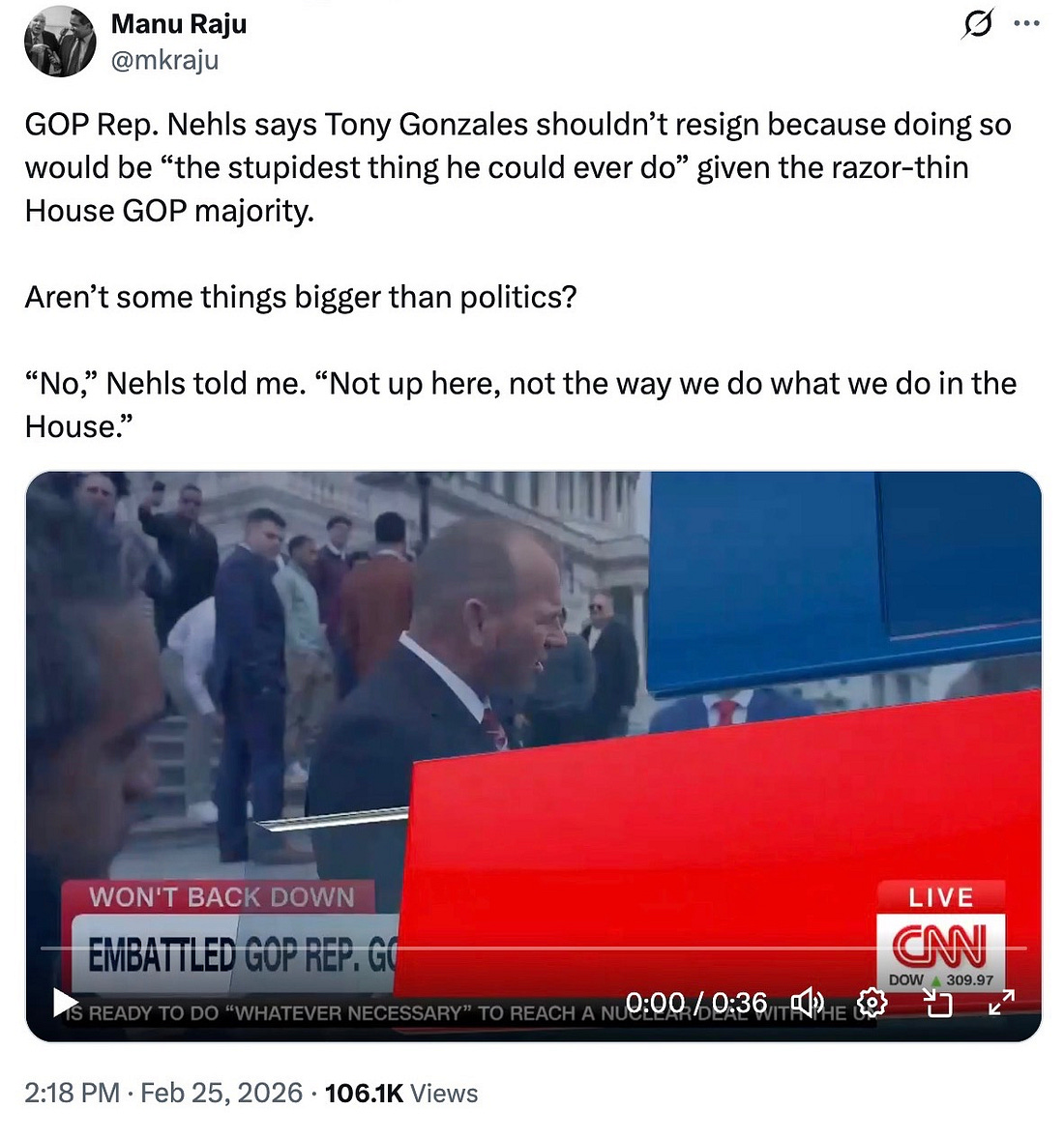
Another day, another round of insane, racist Truth Social attacks against minority congresswomen from the president of the United States:
Happy Thursday.
Hegseth’s AI Ultimatumby Andrew Egger Who gets to decide when the government AI-bots are ready to start killing people without direct human oversight—the Pentagon or the AI companies? This remarkable—some might say insane—question is at the center of a major standoff between the Defense Department and Anthropic, creator of the AI platform known as Claude. While the Pentagon has contracts with all the leading AI labs, Anthropic until this month was the only one contracted for AI use in classified settings: Claude was, for instance, reportedly involved in the operation to capture Nicolas Maduro. But Defense Secretary Pete Hegseth has grown unhappy with two elements of the DoD’s contract with Anthropic. One, Anthropic won’t let its AI be used to conduct mass surveillance of Americans. Two, it won’t let the DoD use it to operate autonomous weapons systems that can identify, track, and kill targets without direct human involvement. To the Defense Department, the idea that a contractor would be able to tie the military’s hands like this is outlandish; they should be permitted, they argue, to use AI they contract for “for all lawful purposes.”¹ Hegseth could simply drop Anthropic’s contract over this, pivoting instead to any of the AI labs—OpenAI, Google Gemini, Elon Musk’s xAI—that aren’t insisting on these contractual sticking points. But he doesn’t really want to. After all, Claude is supposed to be the best, and at any rate it’s already integrated into lots of DoD systems. It’d be a hassle. So instead, Hegseth has issued Anthropic an ultimatum: Change your policy, or we’re going to start getting nasty. This could happen in a couple different ways. The Defense Department is threatening to use the Defense Production Act to compel Anthropic to drop its usage requirements. Or it could go the exact opposite direction, declaring Anthropic a “supply chain risk”—which would not only eliminate DoD’s Anthropic contract, but also forbid any business that contracts with DoD from working with Anthropic in any way. Both of these, it is hardly sufficient to say, would be enormous, unprecedented escalations. Hegseth says Anthropic has until tomorrow to decide. The fact that DoD is considering both possibilities—making it illegal for Anthropic not to work with them and making it illegal for Anthropic to work with anybody DoD works with—makes it pretty clear that all this is a pure squeeze play. Hegseth doesn’t actually think Anthropic is a supply-chain risk, a label typically reserved for software developed in hostile nations and suspected to contain hidden malign code. He’s just threatening to use the strongest weapon he has against the lab if it doesn’t give him what he wants. The confrontation has spooked the AI-policy world, which has until now viewed the Trump administration as highly AI-friendly. This week, I spoke with Dean Ball, who worked in a senior AI-policy role at the White House last year, helping the Trump administration develop its AI Action Plan. Ball now serves as a senior fellow at the Foundation for American Innovation, a newly influential think tank on the tech right. In Ball’s view, the actual dispute between Hegseth and Anthropic had reasonable points on both sides: The government wants to control its own military, and Anthropic doesn’t want to be involved in specific use cases, so whatever—seems like they should go their separate ways. But Hegseth’s ultimatum was a whole different beast. Throughout our conversation, Ball seemed to struggle to summon words powerful enough to express his incredulity at what he called the DoD’s “giant escalation.” “I will say this in no uncertain terms, bipartisan, regardless of administration,” Ball said. “This would be one of the worst things for the American business climate I have ever seen the government do.” I asked the White House how Hegseth’s threatened kneecapping of Anthropic was in keeping with their broader AI policy, which has placed a huge priority on unleashing U.S. AI capabilities as part of a global AI arms race against China. The White House referred me back to the Pentagon; the Pentagon did not respond to my comment request. Even when they’re the targets of ludicrous government bullying, AI labs don’t necessarily make for the most sympathetic victims, which perhaps explains why we haven’t seen more Democrats rallying to Anthropic’s defense. One exception is Rep. Zoe Lofgren (D-Calif.), who serves as the ranking member of the House Committee on Science, Space, and Technology. In a statement to The Bulwark, Lofgren said that the administration’s “bullying tactics” against Anthropic were “shocking and senseless.” “Anthropic is trying to do the right thing and put their own guardrails in place in the absence of legislation,” she added. “It should go without saying that AI technology should not be making potentially lethal decisions without human involvement. I fear what America will become if the DoD is given this unrestricted power.” Maybe that’s the biggest takeaway from this whole crazy story: While it’s nice that Anthropic is digging in their heels here, it’s insane that such questions as “how much killing will we let the killer robots do on their own” are being hashed out as back-room handshakes between the military and its AI contractors in the first place. This seems like a matter of public policy if ever there was one. Have we got a legislature or what? If Congress were actually to do its job and legislate on this issue, what’s the right answer? And what would be the right solution to this standoff if your favorite administration were in power? Share your thoughts in the comments. Trump’s Murder Stories: A Case Studyby Cathy Young Donald Trump’s State of the Union address was designed, at least in part, to trap Democrats in a no-win situation in which they participate in Trump’s theatrics either by joining in or by being shamed for not joining in. And lo: There has been much right-wing indignation over congressional Democrats’ failure to stand for Donald Trump’s tribute to Iryna Zarutska, the Ukrainian refugee fatally stabbed in Charlotte, North Carolina last August. (Her mother, Anna Zarutska, was in attendance.) That faux outrage is morally bankrupt. For starters, MAGA couldn’t care less about the Ukrainians slaughtered daily in the war from which Zarutska fled. MAGA influencer Matt Van Swol, who asserted that the Democrats’ refusal to stand may have been his life’s “most radicalizing moment,” had previously been “radicalized” by Joe Biden giving billions to Ukraine and Volodymyr Zelensky not wearing a suit. The only reason Trump cares about Zarutska is because he could blame her slaying on criminal-coddling Democrats: The killer, Trump declared, “had been arrested over a dozen times and was released through no-cash bail.” In reality, DeCarlos Brown had previously served five years for robbery; his recent no-cash bail release was over misusing 911 calls during a schizophrenic episode. (The real problem was not leniency but failure of psychiatric interventions.) For quite a few on the far right, the story also fits a racist narrative of black criminality and anti-white terrorism. It gets worse still: Trump managed to spin a refugee’s tragic death into an attack on immigration, falsely claiming that the U.S.-born suspect “came in through open borders.” The next day, Sen. Ron Johnson of Wisconsin told CNN’s Jake Tapper that Zarutska was killed “by an illegal immigrant.” From Trump gaffe (or lie) to GOP talking point. In other words, Trump cares about Zarutska not because of who she was, but because of who he imagined her killer to be. Trump’s demagoguing of Zarutska’s genuinely horrifying murder grates all the more because, earlier that day, the United States had abstained from a United Nations resolution backing Ukraine on the fourth anniversary of the Russian invasion. Meanwhile, civilian deaths in Ukraine have surged in the past year while Trump’s “peacemaking” buffoonery gave Putin room to prolong the war. Worse, while Trump sheds crocodile tears for Zarutska, his administration is moving to strip Ukrainian refugees like her of protected status—which could mean deportation into peril. Trump told a whole Scheherazade’s worth of stories in his speech. The scale of the tendentious lying is almost hard to believe. AROUND THE BULWARK
Quick HitsPLEASE, SIR, MAY I HAVE SOME MERGER?: Donald Trump has been building up a head of steam against Netflix lately, so the streaming giant seems worried its planned acquisition of Warner Bros. may be entering stormy waters. Days after Trump publicly demanded Netflix fire Obama-alum board member Susan Rice “or pay the consequences,” CEO Ted Sarandos is heading to the White House today to try to smooth things over. Politico reports:
Billions of dollars and the fates of some of the biggest entertainment products and companies in the world are in the balance—and it really may all come down to who can most vigorously gladhand the president. Just another day of normal business in 2025 Trumplandia. OKAY, NOT OUR BEST IDEA: It was the MAGA brainstorm to end all MAGA brainstorms: “What if we put the great men and women of ICE to work busting crime at polling places?” The idea had been gaining popularity in some corners of the right this month. Steve Bannon pushed it on his “War Room” podcast, Karoline Leavitt dismissed the idea as “ridiculous” but declined to totally rule it out, and—as we wrote last week—MAGA lawmakers in Arizona introduced legislation that would have required county officials to welcome ICE oversight. Now, Republicans are more aggressively backing away from the idea. The Arizona bill—which would never have survived Democratic Gov. Katie Hobbs’s veto—was pulled before a vote amid a widespread voter outcry. And yesterday, the Department of Homeland Security assured election officials around the country in no uncertain terms that ICE wouldn’t be involved in election integrity efforts: “Any suggestion that ICE is going to be present at polling places is simply disinformation,” DHS Assistant Secretary for Election Integrity Heather Honey said, according to NPR. “There will be no ICE presence at polling locations.” In a statement to The Bulwark, however, DHS reintroduced a smidge of ambiguity. “ICE is not planning operations targeting polling locations,” an official said in an email. “ICE conducts intelligence-driven targeted enforcement, and if an active public safety threat endangered a polling location, they may be arrested as a result of that targeted enforcement action.” CASEY AT THE BAT: Dr. Casey Means, Donald Trump’s pick for surgeon general, may not be one of the president’s worst nominees, but she’s certainly among the kookiest. A wellness influencer, vaccine skeptic, and RFK Jr. ally—her brother Calley Means is a top aide at HHS—Means’s history of crunchy and kooky content caused plenty of head-scratching when her nomination was announced last year. It’s not hard to figure out why:
Yesterday, in her confirmation hearing before the Senate Health Committee—ahead of what is expected to be an uneventful party-line confirmation vote—Means repeatedly dodged questions of whether she believed vaccines cause autism and if she would encourage American parents to vaccinate their children, although she did say that “vaccines save lives” and that she would encourage parents to talk to their doctors. Meanwhile, Means said she had “significant concerns” about the use of pesticides like glyphosate—unsurprising, given her past anti-pesticide campaigning, but notable given the Trump administration’s actions this month to boost U.S. glyphosate production. Cheap Shots
1 Nothing in current U.S. law or even current Defense Department policy forbids the development or eventual use of what they call “lethal autonomous weapon systems,” or LAWS. DoD Directive 3000.09 requires that all weapons systems be designed to “allow commanders and operators to exercise appropriate levels of human judgment over the use of force.” But as a Congressional Research Service paper noted last year, “human judgment over the use of force” merely means humans must be broadly involved “in decisions about how, when, where, and why the weapon will be deployed.” In other words, DoD’s current policy toward hypothetical future AI weapons is that they would require lots of post-training and pre-mission human oversight, but could then be let off the leash to conduct operations without direct human control or involvement. You’re a free subscriber to The Bulwark—the largest pro-democracy news and analysis bundle on Substack. For unfettered access to all our newsletters and to access ad-free and member-only shows, become a paying subscriber.We’re going to send you a lot of content—newsletters and alerts for shows so you can read and watch on your schedule. Don’t care for so much email? You can update your personal email preferences as often as you like. To update the list of newsletters or alerts you received from The Bulwark, click here. Having trouble with something related to your account? Check out our constantly-updated FAQ, which likely has an answer for you.
|
AI Death Machines. No Human Oversight. What Could Go Wrong?
February 26, 2026
0